60s gadgets

Image by de:Benutzer:HPH (taken at the "Russia in Space" exhibition, Airport of Frankfurt, Germany, 2002) licensed under Attribution-ShareAlike 3.0 Unported (CC BY-SA 3.0)
In the sixties, technology was exciting. The space race began when Soviet cosmonaut, Yuri Gagarin, became the first man in space in 1961.
The obsession with rocket imagery and silver foil reached its peak in 1969 when Neil Armstrong took that small step onto the surface of the moon. TV companies beamed live into coverage into households across the world. A few lucky people saw it in colour.
A more sinister development from 1961 was the Berlin Wall, which separated East and West Berlin.
The Cold War inspired a run of spy films. Millions read books by Len Deighton, Ian Fleming and John Le Carré
The James Bond films showcased new technology and gave an insight into a glamorous fantasy world.

Image by FR via Wikimedia Commons licensed and distributed under Attribution-ShareAlike 4.0 International (CC BY-SA 4.0). Image cropped
The hothouse of the Second World War and the Cold War produced numerous technological spin-offs.
At the start of the sixties we already had transistor radios and computers. In 1962 Telstar beamed television pictures by satellite across the Atlantic. It seemed that technology would conquer all.
This selection of gadgets from the sixties gives an insight into the technology ordinary people used. We also show some gadgets from the cutting edge.
Music and hi-fi
Pocket transistor radio

In the sixties every teenager had a transistor radio. They were cheap, colourful and highly desirable.
You could have music and news on the move. The transistor radio, or 'transistor' or 'tranny', was the passport to the modern world. It showed that you were part of the "with it" generation.
People in Third World countries saved hard to get one. Transistors were vital to keep up with news and events. It gave people a chance to find out what was really going in countries where the government controlled the media.
At first, styling was influenced by American automobiles. However, from the later sixties a more modernist design ethic appeared.
Quality was low, but you could not be part of the Swinging Sixties without a transistor radio.
The radio above is a Pye - "Empire Made" (so made in Hong Kong then!). Here there is hint of the space age on the front of the radio.
Why was it hip?
- Pop music on the move
- Compact and light
- Every teenager wanted one
- Space-age styling

Image by Frankie Roberto licensed under Attribution 2.0 Generic (CC BY 2.0). Image cropped
The prize for the smallest radio in the 1960s went to Clive Sinclair. His radios were miniature in the extreme. They were sold in kit form via popular hobbyist magazines. They are rare and collectable today.
Stereo radiogram

At the other extreme hi-fi was huge in the 1960s. Stereo systems with separate tuners, amplifiers and speakers were bought by hi-fi enthusiasts. Most people opted for a stereo-radiogram. They were often a piece of furniture the size of sideboard.
This German example was built to the highest quality. It cost DM 1178 when new. That translates to £106 or $296. In today's money it would be £1600 or $2200.
For that you got AM and FM radios, stereo speakers and a Dual turntable.
Phillips EL3300 cassette tape recorder

This was the world's first cassette tape recorder. It came complete with a microphone so that you could record your own voice.
Philips called the cassettes cartridges. It was a cartridge-loading pocket tape recorder, not a cassette tape recorder, in the early adverts.
The EL3300 was a high quality and expensive product. I can testify to the quality since I still use one today.
In 1964 you would have to fork out 25 guineas for one (£26 5s). That would be about £400 in today's money.
Today these are very rare. If you want one, look for an EL3302. It was a slightly later model and more common. A working one should cost around £20.
Why is it cool?
- The first cassette tape recorder
- Cutting edge technology
- Neat, minimalist styling
- High quality product
Calculators

The electronic revolution was just around the corner in the 1960s. The first pocket electronic calculators went on sale in the early 1970s. A few precursors appeared in the 1960s. The desktop electronic calculator was slowly replacing the mechanical or electro-mechanical adding machines of the 1950s.
Magic Brain calculator

Electronic portable calculators did not go on sale until 1971. But that didn't mean you couldn't have a pocket calculator in the 1960s.
The Magic Brain used an age-old design that could add, subtract and multiply using mechanical parts and a stylus.
The clever part of the design was how it worked out the carry forward, or borrow when you added or subtracted. You can be quite quick with one of these once you have mastered the knack.
There were different models for the UK market that could add up in pounds, shillings and pence.
The Magic Brain could cope with the weekly shop or the kids' homework, but 1960s' engineers and scientists still preferred a slide rule.
You could get a Magic Brain for just $1 in 1960. They were still sold into the early 1970s, before electronic calculators became cheap enough for everyone.
Personal items
Samsonite Classic attaché case
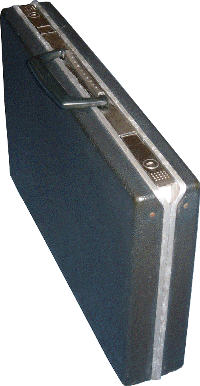
In the sixties, the Samsonite Classic attaché case was the coolest business accessory.
It was the case of choice for the discerning secret agent. Michael Caine carried one in "Funeral in Berlin" (1966) and James Bond had one in "You Only live Twice" (1967).
The design is simple, stylish and modern. New materials abounded - hard-wearing plastic exterior and a lightweight magnesium frame. There are also some substantial locks - not the one key fits all as on most other brief cases of the era.
Samsonite luggage was made by Shwayder Bros. The company had a reputation for quality and innovation.
In the 1940s their Streamlite case was aimed at the growing number of airline passengers. As the jet age dawned they launched the Silhouette case taking advantage of the properties of glass fibre and magnesium to produce a design that looked modern and stylish, but was also light and strong.
The Classic attaché was a result of careful market research and captured the mood of the sixties' executive. It was the first product launched under the leadership of King Shwayder, who took over as president when his father Jesse relinquished the role in 1961.
Parker 61

This pen had a special capillary filling mechanism with no moving parts. You simply unscrewed the barrel and placed the filler upside down in an ink bottle and the ink soaked up. In practice they performed poorly and often clogged up. Go for a later model with a cartridge filler if you want a more usable pen.
Philishave battery shaver

Even the humble shaver could look cool in the sixties. This battery shaver dates from 1967. It is an early example of the Philishave range. The two rotating heads have more than a passing resemblance to the air intakes of jet engines. Just the thing to pack in the hand luggage!
Photography
Pentax Spotmatic SP 35mm SLR

The coolest camera of the sixties was the Pentax Spotmatic SP.
Pentax launched the ground-breaking Spotmatic with through-the-lens metering in 1964, just in time for the Tokyo Olympics. These cameras were the first choice of professionals and amateurs alike.
They were lightweight (for the time) and easy to use. They take cracking pictures, if you haven't gone digital yet. For the ultimate in sixties cool, go for a black Spotmatic.

Instant photography
The Polaroid Swinger provided instant pictures. You did not have to send them off to be developed. This camera was launched in 1966 in the UK. It must have been a big hit at Christmas. The name was very much in keeping with the spirit of the decade. Photographs were only black and white, but then so was television. It also had a slot for flash cubes - remember those?
Binoculars

The number one binoculars in the sixties were made by Carl Zeiss in Western Germany. After the War, the Zeiss factory remained in the East, but many of the key workers moved to the West and established a new factory. The East German factory carried on as a rival, under the name Carl Zeiss, Jena. They stuck with old technology, whilst binoculars made in the West got better. By the sixties, the Western firm was the leading name in binoculars and the choice of the rich and famous.
Zeiss Binoculars from this era still command a premium in price, so we have chosen a British offering for this feature. These Solaross Binoculars (right) have quality optics, almost as good as Zeiss, a leather case and are lightweight and easy to use.
Watches
Bulova Accutron

They didn't have quartz watches in the sixties, although they did have electronic watches. The Bulova Accutron, which used a miniature tuning fork to regulate the movement, was one of the first. Some of the first models were made without the face so that salesmen could demonstrate the movement to customers. The idea was so cool that it caught on and Accutrons were sold without the face. These watches were known as "Spaceview". This model is an Accutron Apollo from 1970, made to coincide with the Apollo Space Programme.
60s communications
Trimphone

The Trimphone was the nearest you could get to a mobile phone in the sixties. A long cable with a stretchable curly cord meant that you could carry it around at parties. It was the first phone without a bell ringer - an electronic warble, which was imitated by birds, provided the ring tone. The trimphone had an illuminated dial and a new type of handset. It was stylish and modern. Just the thing for a swinging sixties pad. You could choose from two-tone blue (shown), grey/green or grey/white. You couldn't buy one, but had to rent one from the GPO for a few extra shillings per quarter.
Although the design by Martyn Rowlands dates from 1964, the GPO took a long while to get it right. Field trials started in 1965, but you couldn't have one otherwise until the end of the sixties.
In the kitchen
Kenwood Chef

Is there anything the Kenwood Chef can't do? So said the TV advert. The Kenwood Chef was the most desirable kitchen accessory in the 1960s.
It was in fact a product of the 1950s. But the design is from the 1960s.
The original Kenwood Chef had an enamelled metal case and looked utilitarian. It was the kind of thing a professional chef would have used, at a time when professional chefs weren't celebrities. The owner of the Kenwood, Ken Wood, asked another Ken, Kenneth Grange, to re-style it.
It was Grange's re-skin that gave the Kenwood Chef its kudos.
Russell Hobbs K2
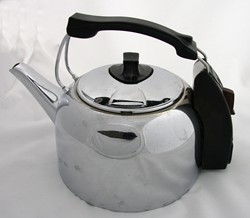
The Russell Hobbs K2 was one of the most expensive kettles you could buy in the 1960s. It had one feature the others did not. It switched itself off when the water boiled.
Most people in the 1960s either had an electric kettle which you had to watch when it boiled or stove top whistling kettle. Swan made an electric kettle with a whistle. But why bother with a whistle at all if you had the K2?
The Russell Hobbs K2 was the definitive kettle for two decades until thejug kettle knocked it off its perch in the 1980s.
By Steven Braggs, July 2006, updated August 2021




Comments