Life in the 70s
The BBC's TV drama "Life on Mars" took a regular guy from the 21st century and plonked him right back in the 70s - the decade he grew up in. But what would it actually be like to live in the 70s? If we, like Sam Tyler, suddenly found ourselves transported back to the decade of flared trousers and glam rock, then we would find it just a little bit old fashioned. But how a person used to modern life would survive in the 70s is not really the question we should be asking. Obviously no-one living in the 70s missed mobile phones. Like any other decade the 70s saw itself as up to the minute modern, both in terms of technology and the way in which people lived. After all it was more modern than any decade before!
What was new in the 70s?
Cassette tape recorders
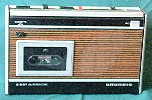
It's hard to believe now, but in the 70s we thought cassette tapes were the latest thing. They had actually been around since the 60s (See Phillips E3300), but as with all new developments things can take a little while to catch on. However, it wasn't until the 70s that people started to buy and use them in large numbers. Phillips modernised their 60s offering, it became the E3302 with a neater, more modern style in brushed chrome and black. The Grundig model (left) used fake wood to give a teak look which was very common in the 70s, especially in car interiors.
Music centres, colour TVs and more...
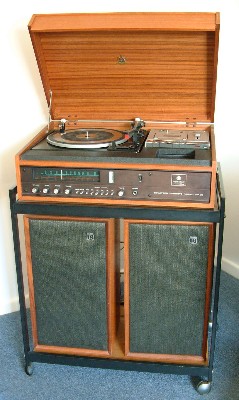
The ultimate piece of kit that most people wanted in the mid 70s was a "Music Centre". This was a record player, cassette tape recorder and radio combined. Dynatron made one of the first, the HFC38 Stereo/Audio Cassette System, launched in 1972. This was a high priced luxury item at the time.
Colour television was still quite new and many people bought or rented their first colour sets in the 70s. Prices of colour TVs dropped, relative to earnings at least, in the 70s. Another exciting symbol of the modern world was the trimphone. You still had to rent these from the GPO and pay a little extra per quarter to have one. Right at the end of the decade the GPO went retro and brought back candlestick phones.
Towards the end of the 70s, hints of the technological revolution just around the corner started to appear. There was the computer tennis game "Pong", microwave ovens and video recorders.
Healthy food
In the 70s, we started to buy yogurts and muesli in larger and larger quantities. These had both been seen as "fad" foods bought by a minority of eccentrics in the past. In the 70s, they were becoming mainstream. At the beginning of the decade you might have to go to a health food shop to buy muesli; by the middle of the decade it was more commonly available in supermarkets.
Tea bags
Tea bags were new in the 70s. Well not exactly new, they had been used in the USA since the 20s. Tetley had tried introducing them to the UK twice, once in the 30s and again in the 50s, but they were seen as a bit of a joke. In the 70s though, sales of tea bags took off. It's hard to explain why, they were more expensive and rarely used in the way originally intended - to remove the tea from the pot once it was brewed. It may have been something to do with convenience. We could throw our tea strainers away. Now tea bags are almost universal - so they must have been a good idea after all!
Continental quilts
Until the 70s, most people in the UK made up beds with sheets and blankets. In the early 70s the bedroom revolution was the continental quilt or duvet. Names such as "Slumberland Fjord" and "Banlite Continental" left no doubt as to the origin. Mostly they were filled with down or duck feathers. Synthetic fillings were more common in Europe, but became available in the UK. People quickly took to them as they were more convenient.
What did we worry about in the 70s?
The Common Market
Before we went "into Europe" we worried about whether we should. Britain was in a mess and everything was much better in Europe. The Daily Mail told us that the Germans and French had more cars and 'fridges per head of population than we did. But, and it was a big but, the price of food, particularly butter, was much higher in Europe.
In 1973 we went into Europe. Then we worried about whether we should stay in and got our chance in 1975 to say "Non", or should that be "Nein". In the event we chose to stay in, though we still worried about the price of butter!
Inflation and unemployment
In fact we worried about the price of everything in the 70s. It was the decade of rampant inflation. Prices went up and up, year after year, at an alarming rate. "Which" published surveys every year about the cost of groceries and Les Dawson did his bit with the "5 Dawson Watch" basket - all he could afford was a loaf of bread and a bottle of whisky. He found the bread too expensive and just bought the whisky!
Later on it was the decade of unemployment - we hadn't had the 80s yet - so we didn't know it really wasn't. Does any one remember those Saatchi posters telling us that "Labour isn't working"?
Strikes
The 70s was the decade of strikes. Union muscle had been flexed in the 50s and 60s, as rising prosperity and near full employment made people feel that their jobs were safe and they could ask for more. It was the 70s though, that felt the full force of what the unions could do. They beset both Ted Heath and Jim Callaghan's governments with problems throughout the decade, culminating in the "Winter of Discontent".
Northern Ireland
The "Troubles" in Northern Ireland dominated the headlines in the 70s. A number of high profile mainland bombing campaigns in the mid 70s threatened London and major British cities. Peace in Northern Ireland seemed a distant hope.
So what was there to be cheery about?
It was the Queen's Silver Jubilee in 1977. Aside from that there wasn't much. England lost the World Cup in 1970 and humiliatingly failed to even qualify for the competition in 1978.
Still we had flared trousers, Watney's Red Barrel and "It's a Knockout"!


